Literacy & Reading

At Ash Green, we are invested in developing the literacy and reading skills of every child at our school. We seek to identify any gaps in literacy at the earliest point and to provide suitable support to meet the child’s individual needs. We also aim to encourage all students to have the opportunity to develop a lifelong love of reading.
Our vision
It is our vision at Ash Green School for every child to develop their love of reading, and for every child to be supported to read at a level in which they can access the curriculum successfully. We achieve this by regularly reviewing our literacy and reading strategy and developing robust action and professional development plans to support all children to develop their reading. We are committed to keeping up to date with current research into effective support for reading and supporting students who are behind with their reading. We use a number of approaches to make sure your child receives the best education.
Meet the Team
Literacy and reading is headed up at Ash Green School by the Assistant Principal, Adrian Moore . He can be contacted to discuss anything regarding literacy and reading at the following email:

Adrian Moore
Assistant Principal
adrian.moore@ashgreenschool.org.uk
Key Dates
- 3 December 4.30pm – 5.30pm – Workshop – Supporting parents to meet the needs of dyslexic learners
- 4 February – 4.30pm – 5.30pm – Workshop – Supporting reading at home for the reluctant reader
- 24th June – 4.30pm – 5.30pm – Workshop – Parental support session for students on Lexia training
Supporting Reading at Home
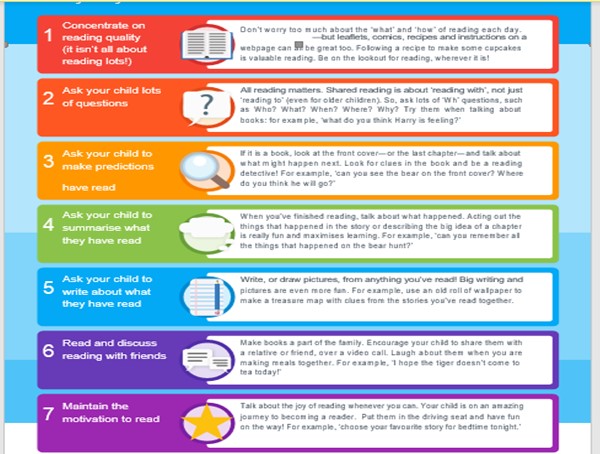
To support you and your child, I wanted to let you know about the ‘7 Top Tips to Support Reading at Home‘ resource from the EEF (Education Endowment Foundation) shared at the foot of the page.
This is designed specifically to be shared with families to support you in developing your child’s reading skills as regular reading routines can offer lots of opportunities for learning during school closures.
We also wanted to remind you of the great resources out there, such as Oxford Owls https://home.oxfordowl.co.uk/ . This resource has a library of activities and resources for every stage of the learning journey, organised and delivered by the team at Oxford University Press, to support all aspects of reading, in the classroom, at home and beyond.
Just click on the sections in the menu to explore by subject, or use the options below to uncover content by age group.
Why read to your child:
https://www.youtube.com/watch?v=2UmwXQwx5gk
Reading for pleasure:
https://home.oxfordowl.co.uk/reading/reading-for-pleasure/
Supporting struggling readers:
https://home.oxfordowl.co.uk/reading/struggling-readers/
Free book library:
https://home.oxfordowl.co.uk/reading/free-ebooks/
We also want inform you of some other great resources, such as the Literacy Trust and their parent facing forum platform, words for life; for children up to and including 12. This site gives developmental milestones, tips, fun resources and advice to help parents support children’s literacy development.
This site gives developmental milestones, tips, fun resources and advice to help parents support children’s literacy development. For children 13 and over, have a look at https://wordsforlife.org.uk/zone-in . Here you will find the best tips to boost young adults reading, writing, speaking and listening skills.
Top reading tips
Shared reading is a great way to develop children’s language and communication and to boost their reading skills. Regular reading routines can offer lots of opportunities for learning outside of school.
Ash Green Academy Reading Support Pathways 2025-26
At Ash Green school we have a reading catch-up programme, where we regularly assess students’ reading ability, identify specific, phonological, fluency and comprehension gaps, and place them on the relevant reading support pathway.
We use the NGRT to test every student’s reading age and 'Standard Age Score'. Using these results, we target students who are on reading pathway A-D with SAS scores below national average.
The NGRT results are used to place students on the various reading support pathways.
The SAS is based on the student’s raw score which has been adjusted for age and placed on a scale that makes a comparison with a nationally representative sample of same age across the UK.
The average score is 100. The SAS is key to benchmarking and tracking progress and is the fairest way to compare the performance of different students within a year group or across year groups.
Once the NGRT is complete, students are placed onto one of our Reading Support Pathways where they undergo further diagnostic assessment to ensure that this best meets their individual needs.
|
Pathway |
Profile Description |
|
A |
NGRT reveals potential phonics gaps - Stanine 1 (Very low) |
|
B |
NGRT reveals potential phonics gaps - Stanine 1-3 (Below Average) |
|
C |
Reading is limited by poor vocabulary, syntax and grammar knowledge - Stanine 3-5 (Below Average - Average) |
|
D |
Reading is limited by poor comprehension and / or fluency - Stanine 3-6 (Below Average - Average) |
Reading Support Pathways intervention 2025-26
Following short, sharp and highly effective interventions, students are re-tested every six weeks, and move up through the reading support pathways accordingly.
We closely monitor the reading comprehension and fluency levels of all students involved in our reading support pathways using carefully designed rubrics across a variety of skills. Depending on their individual pathway, will depend on their intervention, these include:
- Lexia reading proramme
- Phonics
- Guided reading
- Reciprocal reading
- Buddy reading
- Sprax reader
Sparx Reader
- Every pupil at Ash Green also has access to Sparx reader. Sparx Reader is a reading, comprehension and vocabulary programme that gets all young people reading regularly to help improve their literacy. Students choose a book from the online catalogue, that is linked to their reading age and starting point; sparx reader then regularly checks their understanding of the story throughout the book. This is used as a targeted intervention tool for identified pupils, but also for homework within the English department.